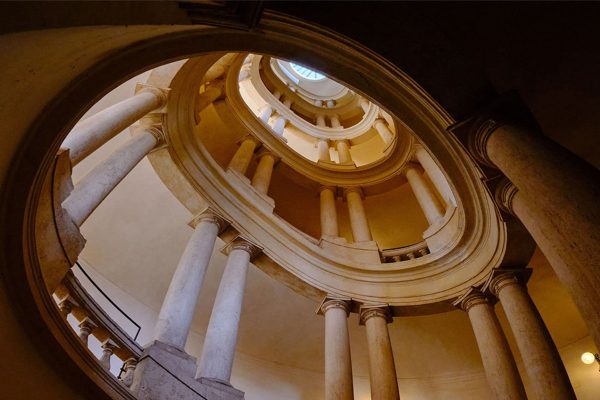
Palazzo Barberini is this extraordinary Roman building that, located in the heart of the Eternal City, houses artistic treasures that tell of one of the most fascinating moments in Italian history: the Baroque.
Among these masterpieces, one of the most important and spectacular is the fresco The Triumph of Divine Providence by Pietro da Cortona, an artist whose work defined an entire style of painting. Created between 1632 and 1639, this fresco celebrates the power and prestige of the Barberini family through a monumental, vibrant and striking composition.
In the article I will take you on a discovery of this unique work, telling you its history, the hidden meanings behind every detail, and the extraordinary techniques used by Pietro da Cortona. And if you eventually want to live this unique experience, you can find all the necessary information on our tickets page, to plan your visit to Palazzo Barberini and Galleria Corsini.
Let’s set off together on this journey into the heart of Roman Baroque!

Palazzo Barberini Tickets
Buy now. Choose your preferred time. Places for Palazzo Barberini are limited: don’t miss the masterpieces of Caravaggio, Raphael and Pietro da Cortona.
You can cancel for free up to the day before your visit.
Triumph of Divine Providence: the story

The Triumph of Divine Providence – Photo by Wikipedia
When you visit Palazzo Barberini in the heart of Rome, you immediately have the feeling of entering a special place steeped in history and art. Commissioned by Pope Urban VIII (born Maffeo Barberini), the Palazzo Barberini represents the height of prestige and power achieved by the Barberini family in the 17th century.
But the real gem of this place is on the main floor, in the great central hall, where you can admire the fresco The Triumph of Divine Providence, an absolute masterpiece by Pietro da Cortona.
The Birth

Glimpse of the vault – Photo by Wikipedia
The story of the fresco begins in 1632, when Pope Urban VIII entrusted Pietro da Cortona, a young but already established Tuscan artist, with an extraordinarily ambitious commission: to decorate the ceiling of the reception hall of his family’s new palace. It was Urban VIII himself, with the intercession of his nephew Cardinal Francesco Barberini, who preferred Pietro da Cortona to the previous candidate, Mannerist Andrea Camassei.
The challenge was enormous: to create a fresco of about 600 square meters, second in size in Rome only to the Sistine Chapel. It took Pietro da Cortona a full seven years (from 1632 to 1639), interspersed with breaks due to other commitments and sojourns outside Rome, to complete the work.
An exceptional iconographic program

Self-portrait of Pietro da Cortona – Photo by Wikipedia
The subject to be depicted was devised by Francesco Bracciolini, a poet and trusted man of the Barberini family. Bracciolini had already celebrated the election of Urban VIII in the poem entitled L’elettione di Urbano Papa VIII, and it was this poem that provided the inspiration for the fresco.
The chosen theme celebrates the Barberini family as the protagonist predestined by Divine Providence to lead the Christian world. The fresco thus represents a grandiose eulogy of the papal household, skillfully interweaving religious and classical allegories, mythological figures and heraldic symbols.
Pietro da Cortona and his collaborators
Pietro da Cortona worked with great creative autonomy, although he availed himself of the collaboration of a number of artists in his circle, such as Giovan Francesco Romanelli and Giovanni Maria Bottalla. There was no shortage of difficulties and disagreements: during a period of Cortona’s absence from Rome, Romanelli even attempted to take over the fresco from him, causing tensions with the master and leading to his ultimate exclusion from the project.
Despite these difficulties, the work was completed in 1639 and officially inaugurated in the presence of Urban VIII himself, who had followed the progress of the work with constant attention and interest.
Reception and influence of the work
From its unveiling in 1639, Pietro da Cortona ‘s fresco immediately became one of the most celebrated works of the Roman Baroque. Its enormous visual impact, combined with its iconographic complexity, left contemporaries and later artists literally speechless.
The first reception
At the time, the grandeur of Cortona’s work was received with enormous enthusiasm, but also with great curiosity and debate. Artists, critics, and visitors of the time were especially impressed by the stylistic novelty and spectacular perspective illusion, so much so that the fresco immediately became a model to follow.
However, there was no shortage of criticism, especially from more conservative circles, which saw Cortona’s painting as a radical break with the Renaissance tradition. Nevertheless, the success was enormous and definitely consolidated the artist’s fame, consecrating him as one of the absolute protagonists of the Baroque.
International diffusion and prints

Detail of the Barberini shield – Photo by Wikipedia
The fame of The Triumph of Divine Providence did not remain confined to Rome, but spread rapidly throughout Europe thanks to prints and engravings that reproduced its details and compositions. Engravers and artists of the time produced numerous reproductions of the fresco, which circulated widely and helped make the work known far beyond the borders of Italy.
These prints also allowed Cortona to exert a strong influence on foreign artists, spreading the Roman Baroque style to France, Austria, Spain, and Flanders, where many painters began to imitate its dynamic and theatrical visual language.
Influence on European Baroque painting
Pietro da Cortona’s work thus became a veritable benchmark for Baroque decorative painting throughout Europe. Artists such as Giovanni Battista Gaulli known as Baciccio, Andrea Pozzo, and later Giambattista Tiepolo took their cues from the spatial illusionism, the theatricality of the scenes, and the dynamism of the figures introduced by Cortona.
This innovative style, transforming ceilings and walls into grandiose stage representations, became a major feature of Baroque painting in the following decades. The Salone of Palazzo Barberini, therefore, is not only an artistic marvel, but also a fundamental work for understanding the evolution of European art between the 17th and 18th centuries.
Tickets for Palazzo Barberini
Buy now. Choose your preferred time. Places for Palazzo Barberini are limited: don’t miss the masterpieces of Caravaggio, Raphael and Pietro da Cortona.
You can cancel for free up to the day before your visit.
Pietro da Cortona: biography and artistic style
Pietro da Cortona, born Pietro Berrettini, was born in 1596 in Cortona, a Tuscan town from which he takes his name. From a young age he displayed extraordinary artistic talent, fueled by a tireless curiosity about the classical world and the great masters of the Italian Renaissance.
At the age of thirteen, Peter moved to Rome, the city that would become the main stage of his career. Here he carefully studied the works of great masters such as Raphael, Michelangelo, and contemporaries such as Guercino and Rubens, developing an innovative and unmistakable painting style that was destined to become the very symbol of the Roman Baroque.
His big break came when Pope Urban VIII Barberini decided to entrust him, just 36 years old, with the ambitious commission to decorate the ceiling of the main hall of Palazzo Barberini. The result is the masterpiece you can admire today in The Triumph of Divine Providence, a fresco that definitively established him as one of the greatest artists of the 17th century.
The style of Pietro da Cortona
Pietro da Cortona represents Baroque painting at its best: his works are full of movement, vitality, and theatricality. He skillfully uses the illusionistic breakthrough technique (“sott’in su”), making the ceilings of his works appear to be open to the sky, creating spectacular effects of great perspective depth.
His compositions are always very busy and dynamic, animated by moving figures, vibrant colors, and striking details. This style, revolutionary at the time, creates in the viewer the feeling of literally being part of the scene depicted.
Pietro da Cortona himself in his famous “Treatise on Painting and Sculpture” (published in 1652 together with the Jesuit Domenico Ottonelli) affirmed the importance of “always animating pictorial scenes with many characters”-a principle that you can easily find in the grand fresco of Palazzo Barberini.
Analysis of the Triumph of Divine Providence
Upon entering Pietro da Cortona’s Salone at Palazzo Barberini and looking up at the ceiling, you are immediately captured by the swirl of figures, lights, and colors that form the fresco of The Triumph of Divine Providence. At this moment, you are not simply looking at a painted ceiling; you are immersed in a scene that expands beyond the confines of the architecture, opening up to the infinite sky. This is Baroque at its best.
Overall structure and composition
When you look at the ceiling frescoed by Pietro da Cortona, you will have the feeling that you are standing under a giant opening to the sky. The fresco The Triumph of Divine Providence is built according to a precise compositional structure that amplifies the sense of depth and movement, typical of the Baroque style.
The mock illusionistic architecture
When you look at the ceiling of Pietro da Cortona’s Salone, you will get the distinct impression that it literally opens up to the sky, revealing an immense scene that extends beyond the palace’s actual boundaries. This amazing effect is achieved through a technique known as quadraturism, in which the artist creates an illusionistic perspective that tricks your eye into believing you are seeing a real, three-dimensional, ever-expanding space.
Pietro da Cortona was a true master of this art. In his fresco he painted a complex fictitious architectural structure designed with extraordinary precision. This simulated architecture rests ideally on the real cornice of the salon, creating a smooth and natural transition between reality and pictorial fiction.
This illusory architecture consists of four sturdy piers, painted in perfect perspective, that support a grand rectangular cornice painted with such realistic marble effects that it looks as if it were really carved. The piers are decorated with typically Baroque ornamental elements such as putti, floral festoons, dolphins, and mythological figures, further emphasizing the sense of theatricality and movement.
At the top of each pedestal are pairs of tritons and telamons, mythological male figures with vigorous bodies, supporting large octagonal medallions(clypeus). These clipei, painted with a monochrome bronze effect, depict episodes from Roman history and are allegories of the virtues of the Barberini family.
The final effect is extraordinary: the visitor’s eye is lost among realistic details and allegorical figures that seem to float in space, generating a sense of awe and wonder. This technique is not only decorative, but also reinforces the symbolic meaning of the fresco: the glory of the Barberini family, in fact, is not confined within material walls, but symbolically expands to infinity, under the direct will of Divine Providence.
Division into five sectors
If you look at the fresco, you will see that it is clearly divided into five major sectors: a large, rectangular central scene and four side, trapezoidal scenes, each with its own theme and allegory.
Central sector: the heart of the fresco
The central scene represents the heart and deep meaning of the entire fresco: The Triumph of Divine Providence. In the center you can observe Divine Providence, a majestic and regal female figure, seated on a throne made of clouds. Her body is enveloped in golden light, clearly highlighting her divine nature and spiritual superiority. With a raised hand she symbolically commands Fame to crown the Barberini coat of arms, sealing the glorious destiny willed by heaven for the family.
Around Divine Providence you can identify numerous allegorical figures, each with a specific meaning:
- justice, a symbol of just government
- mercy, a reference to clemency and divine love
- power, emblem of the temporal power of the papal family
- truth, guarantor of the authenticity of spiritual power
- beauty and Modesty, referring to the moral and spiritual purity of the Barberini family
Higher up in the scene, the three Theological Virtues (Faith, Hope and Charity) hold a laurel wreath within which fly the famous three golden bees, the heraldic symbol of the Barberini family. The bees represent industriousness, fidelity and union, essential virtues of Urban VIII‘s pontificate.
Allegorical meaning of the figures
Each figure in this central scene has a specific role and a very strong symbolic meaning.
Cronus, who is depicted in the crude act of devouring his children, represents the inexorable passage of time, emphasizing the transience of human life in contrast to the eternity promised by Divine Providence.
The three Fates (Kloto, Lachesi and Atrope), who spinning measure and cut the thread of human life, symbolize man’s destiny and fragility in the face of divine will.
Immortality, depicted by the muse Urania, approaches the Barberini coat of arms with a crown of stars, symbolizing the eternal glory destined for the papal household.
Finally, one can also identify the allegorical figure of the city of Rome, with the papal triregnum, representing the spiritual and temporal power of the Catholic Church led by Urban VIII.
Everything in this scene is designed to emphasize the legitimacy and greatness of the Barberini family as chosen and blessed by divine providence.
The side sections: celebration of the Barberini virtues
The four side sectors, trapezoidal in shape, show allegorical scenes celebrating the “good government” of the Barberini, emphasizing the moral and political virtues of the papal household. Each tells a different story through contrasts and symbolism representing the victory of good over evil and reason over force.
The Triumph of Religion and Spirituality

Triondo of religion – Photo by Wikipedia
In this scene you can admire the stark contrast between two opposing worlds: the world of virtue and faith triumphing, and the world of earthly pleasures and corrupt morality doomed to defeat.
In the center stands the figure of Religion, flanked by Science, the symbol of knowledge enlightened by faith, and Purity, the emblem of spiritual chastity. These three positive figures are depicted with noble and serene attitudes, aware of their moral superiority.
On the left side of the scene, on the other hand, you see Lasciviousness, depicted as a woman of explicit sensuality, stretched out and surrounded by putti and cupids struggling with each other, symbolically representing the tension between Sacred (divine) Love and Profane (earthly) Love. Just above, you can noticeHeavenly Love chasing away little Cupid, a symbol of worldly love and the superficiality of human passions.
Around Lascivia, some maidens are mirrored and combing their hair near a fountain, an image of worldly vanity. On the right, however, Silenus, a mythological character associated with wine and excess, stands out, surrounded by fauns and satyrs, symbols of debauchery.
This stark juxtaposition is a precise allegory of the moral mission of Pope Urban VIII‘s pontificate, which is intended to guide humanity toward spirituality, morality, and divine knowledge, steering it away from earthly temptations.
The Triumph of Peace over Wrath

Peace triumph on the furore – Photo by Wikipedia
This scene, which you can admire on the long side of the vault frescoed by Pietro da Cortona, celebrates the political and diplomatic success of Urban VIII Barberini‘s pontificate: the ability to establish and maintain peace.
In the center, the figure of Peace dominates, seated on a solemn throne. She is flanked by Prudence, who wisely directs her to close the doors of the Temple of Janus, an ancient symbol of newfound peace. These doors, in ancient Rome, were closed only in times of absolute peace, when no war was in progress.
On the left you can see the mighty Cyclopes, mythological figures intent on forging weapons, a symbol of conflict and violence. Their work, however, is in vain: these weapons will no longer be needed, because peace has now triumphed for good.
On the right side, the Wrath, personification of anger and war, is now defeated, disarmed and chained by the allegorical figure of Mansuetude, symbol of gentleness and clemency. The contrast between these figures further emphasizes the central message of the fresco: the peace and harmony brought by the enlightened and peaceful rule of Pope Urban VIII and the Barberini family.
This scene thus represents a true political and moral manifesto, extolling the pacifying and protective role of Urban VIII towards the people and the Church.
Minerva defeats the Giants

Minerva triumphs over the giants – Photo by Wikipedia
This scene immediately engages you because of the powerful perspective effect created by Pietro da Cortona. As you look up, you will see the gigantic bodies of the monstrous Giants rushing toward you, almost ready to overwhelm you. It is a striking visual impression, designed by the artist to amplify the symbolic message.
At the center of the scene dominates Minerva, the Roman goddess of wisdom, strategy, and reason. Armed with spear and shield, Minerva forcefully confronts and defeats the Giants, mythological creatures representing violence, brutality, and above all, ignorance. Her victory is sharp, clear, and final, symbolizing the triumph of reason and culture over blind and destructive force.
In allegorical terms, Minerva represents precisely the intellectual ideal promoted by Urban VIII Barberini, a cultured pontiff and patron of the arts and sciences. The victory of the goddess thus becomes a celebration of the enlightened Barberini government, which used wisdom and culture as weapons to govern and guide the Christian world.
Hercules drives away the Harpies

Hercules drives away the Harpies – Photo by Wikipedia
The last side section of Pietro da Cortona ‘s fresco is dedicated to the triumph of virtue and morality. In the center of the scene you immediately recognize Hercules, hero of classical mythology and universal symbol of strength, courage, and moral rectitude.
In this scene, Hercules is depicted decisively driving away the Harpies, monstrous creatures that are half-women and half-birds, symbols of greed, corruption and all those vices that threaten society. Hence, the presence of Hercules is meant to remind us of the moral strength and integrity of the Barberini, who were able to eliminate evil and protect the people.
Next to Hercules you can also spot the allegorical figure of Liberality, who distributes fruits, flowers and coins. These elements represent the abundance, prosperity, and generosity guaranteed by the good government of Pope Urban VIII Barberini. Through this allegory, Cortona emphasizes the positive and beneficial role of the Barberini family, promoters of the material and spiritual well-being of its subjects.
This scene, so rich in moral and political significance, completes the allegorical cycle extolling the virtues of the Barberini household.
Tickets for Palazzo Barberini
Buy now. Choose your preferred time. Places for Palazzo Barberini are limited: don’t miss the masterpieces of Caravaggio, Raphael and Pietro da Cortona.
You can cancel for free up to the day before your visit.
Iconographic and symbolic analysis
The fresco The Triumph of Divine Providence is an extraordinary combination of symbols, allegories, and iconographic references. Every detail you see has a precise meaning, designed to celebrate the Barberini family and the pontificate of Pope Urban VIII. Let’s discover the main ones together.
The Barberini bees

The three bees – Photo by Wikipedia
One of the most recurrent symbols in the fresco are the three golden bees, the heraldic emblem of the Barberini family. These bees, placed in the center of the main scene, are not chosen at random: they represent industriousness, unity and fidelity, essential values that Urban VIII wanted to associate with his government and family.
The choice of bees also recalls the organizational capacity and sense of duty of the Barberini household toward the people and the Church.
The laurel wreath
The large laurel wreath, supported by the Theological Virtues (Faith, Hope and Charity), represents the eternal glory promised to the Barberini by Providence. The laurel, however, also symbolizes poetic virtue: Urban VIII was in fact also known for his literary, as well as political and religious, talents. In this way, Cortona celebrates both the Pope’s spiritual and cultural roles.
Moral and historical allegories in the medallions (clipei)
In the four corners of the vault you will notice octagonal medallions, called clipei, each containing a scene taken from Roman history. These episodes are not random, but are chosen to represent precise moral virtues attributed to the Barberini:
- Fabius Maximus and the bears, symbols of prudence and political sagacity.
- Scipio and the unicorn, symbol of temperance and moral purity.
- Mucius Scevola and the lion, emblem of strength and courage.
- Titus Manlius and the hippogriff, symbol of insight and justice.
Each animal associated with the historical scenes visually reinforces the virtue it represents, creating a direct link between the ancient greatness of Rome and the contemporary greatness of the Barberini.
Contrasts between vices and virtues
A key aspect of the fresco is the continuous contrast between positive and negative figures, between virtues and vices. Cortona always highlights the victory of morality and reason over moral disorder and violence:
- Religion and Science prevail over lasciviousness and worldly superficiality.
- Peace, guided by Prudence, defeats the Fury of War.
- Minerva, goddess of Wisdom, dominates the Giants, symbol of blind strength and ignorance.
- Hercules, symbol of heroic virtue, drives away the Harpies, allegorical figures of human vices.
These contrasts show how the entire work is a true celebration of the moral, political, and spiritual superiority of the Barberini family, desired and supported by divine Providence.
Spatial illusionism and infinite glory
Cortona’s extraordinary illusionistic perspective finally symbolizes the infinite and divinely legitimized power of the Barberini. There are no clear visual limits: the pictorial space expands upward and beyond the actual boundaries of the architecture. This iconographic solution is meant to communicate the idea that the papal power and glory of the Barberini are destined to transcend temporal limits and enter the eternal dimension.
Painting technique and baroque illusionism
Quadraturism

The three bees – Photo by Wikipedia
Pietro da Cortona masterfully uses a painting technique called quadraturism, based on an extraordinary ability to create perspective illusions. The artist makes use of “from below up” (or from below up) perspective, which gives the impression that the ceiling space literally opens up to the infinite sky. When you look upward, you get the feeling that painted figures and architecture are really three-dimensional and suspended above you.
Every architectural element you observe (columns, piers, cornices, and medallions) is painted with such realistic precision that it appears to be carved from marble. This illusory effect breaks the physical boundaries of the room and brings to life a space that seems to go on forever, creating a visual sensation of unprecedented depth and movement.
Vibrant colors and dramatic light
The fresco is dominated by bright, vibrant colors used to emphasize the movement and dynamism of the figures. Pietro da Cortona carefully chooses bright, contrasting hues that create a strong dramatic effect. You will notice that some figures stand out sharply through bright colors, while others blend gently with the background through softer shades.
Light plays a key role in the composition; Cortona cleverly uses the natural lighting of the hall to enhance the main figures, creating strategic points of light and intensifying the sense of three-dimensionality and depth of the scene.
Technique of execution
From the point of view of execution, the fresco was done through the traditional technique of buon fresco, that is, applying pigments directly onto the still damp plaster. Pietro da Cortona divided the work into many small portions called “giornate,” in which he had to quickly complete each part before the plaster dried. This required speed, precision and great planning skills for the entire work.
During the seven years of work (1632-1639), Cortona also used a number of collaborators such as Giovan Francesco Romanelli and Giovanni Maria Bottalla, although he always maintained total control over the final composition and the most important details of the work.
Stylistic innovation and baroque dynamism
Pietro da Cortona’s great stylistic innovation is to create a dynamic and theatrical painting that breaks with the Renaissance tradition characterized by more static and restrained compositions. His scenes are crowded, animated, and engaging, with figures that literally seem to be moving above you.
This style, innovative for its time, profoundly marked Baroque painting, influencing numerous European artists who looked to Cortona’s work as an indispensable point of reference.
Trivia and anecdotes
Rivalry with Romanelli
During the years when Cortona was working on the fresco, not everything always went smoothly. One well-known episode concerns the rivalry between Pietro da Cortona and one of his collaborators, the young and ambitious Giovan Francesco Romanelli. In fact, Romanelli tried to take advantage of Cortona’s long absence from Rome to try to take over the painting of the fresco. When Cortona returned and discovered his assistant’s initiative, not only did he immediately remove him from the site, but he broke off all relations with him forever.
Long times and continuous interruptions
The fresco took seven long years to complete(1632-1639), with numerous interruptions due to the other commitments of Pietro da Cortona, who was in great demand in Rome and outside the city. Often, in fact, the Pope himself had to intervene, urging the artist to complete the work more quickly. The slow completion was also the subject of criticism and irony from his contemporaries.
The Pope and the Barberini Bees
The three famous golden bees, symbol of the Barberini family, are present everywhere in the fresco. A curious anecdote tells that Pope Urban VIII himself personally controlled the artist’s work, suggesting that Cortona add more bees to better celebrate his family. It seems that Cortona, while respecting the pontiff’s wishes, nevertheless tried to limit their number to avoid compromising the balance and elegance of the work.
An almost record-breaking work
At about 600 square meters, the Palazzo Barberini fresco is the second largest in Rome, surpassed only by Michelangelo’s Sistine Chapel. However, this near-record has always been a source of pride for the Barberini family, which strongly desired a work that could rival that of previous pontiffs.
Do you want to know what other wonderful works are housed inside Palazzo Barberini? We have discussed them in detail in this article.
Conclusion
Pietro da Cortona ‘s fresco of The Triumph of Divine Providence is one of the most important and fascinating works of the Italian Baroque. With its extraordinary symbolic complexity and incredible illusionistic skill, the artist succeeded in celebrating the prestige of the Barberini family, transforming the ceiling of the Salone of Palazzo Barberini into a veritable visual spectacle.
This work is not only an artistic celebration of the family of Pope Urban VIII, but also represents a fundamental landmark in the history of European painting. With its dynamism, theatricality, and ability to emotionally engage you, the fresco has forever marked the evolution of Baroque art, influencing generations of artists and viewers.
Today Palazzo Barberini continues to guard this unique artistic treasure, allowing you to immerse yourself firsthand in the grandeur and magic of Roman Baroque.
If you would like to experience this directly and discover live all the secrets of Pietro da Cortona‘s masterpiece, please visit our tickets page, where you will find all the information you need to organize your visit.
Palazzo Barberini Tickets
Buy now. Choose your preferred time. Places for Palazzo Barberini are limited: don’t miss the masterpieces of Caravaggio, Raphael and Pietro da Cortona.
You can cancel for free up to the day before your visit.